TL;DR: Human-led content starts with a real person's expertise and ends with that person's judgment, with AI helping in the middle. In a feed full of generic posts, it's how experts become known for what they know… and it's exactly what readers and search engines are looking for.
I think we're all a little tired of it.
You open LinkedIn and scroll past post after post that sounds… fine. Polished. Organized into three neat takeaways. And completely forgettable, because it could have been written by anyone. Or by no one at all.
Anyone can generate content in ten seconds now. That's exactly why so much of it gets ignored.
So when people ask what I do, I tell them I'm a human-led content strategist. And then I usually get a little head tilt. (Fair!) So let me walk you through what that actually means, why I think it matters more right now than it ever has… and why I'm not anti-AI, not even a little bit.
What is human-led content?
Human-led content starts with a real person's expertise, stories and opinions, and it ends with that person's judgment.
Everything I do is focused on the expertise that's inside a human's head. The client questions you answer every single week. The project that went sideways and what you learned from it. The opinions you have about your industry that you've maybe never said out loud. The stories you tell over coffee without realizing they're stories.
Nobody else has those. Not your competitors, and definitely not a chatbot.
AI can absolutely help along the way. But it doesn't get to lead.
"I think we're all kind of sick of all of this very generic AI-generated content that we're seeing out there."
A little confession about AI
I'll be honest with you. For a long time, I was hesitant about using AI in my work. I felt almost a little ashamed to say, "Hey, we can do a first draft with AI." It felt funny. Like I was getting away with something.
What got me past that feeling was realizing that the order matters. If AI writes blindly, with nothing from you, you get the same beige content everyone else is getting. But if I sit down with you for an hour, ask you real questions and capture your real words and real stories… and THEN let AI help me organize and research around that transcript? That's a whole different thing. The ideas are yours. AI just helps me move faster.
Someone in my network recently told me about AI avatar tools, where you feed in a script and a digital version of you does the talking on camera. I get why people are excited about that. But when I pictured doing it for my clients, it scared me a little. It just feels like it loses its authenticity… and authenticity is the whole point.
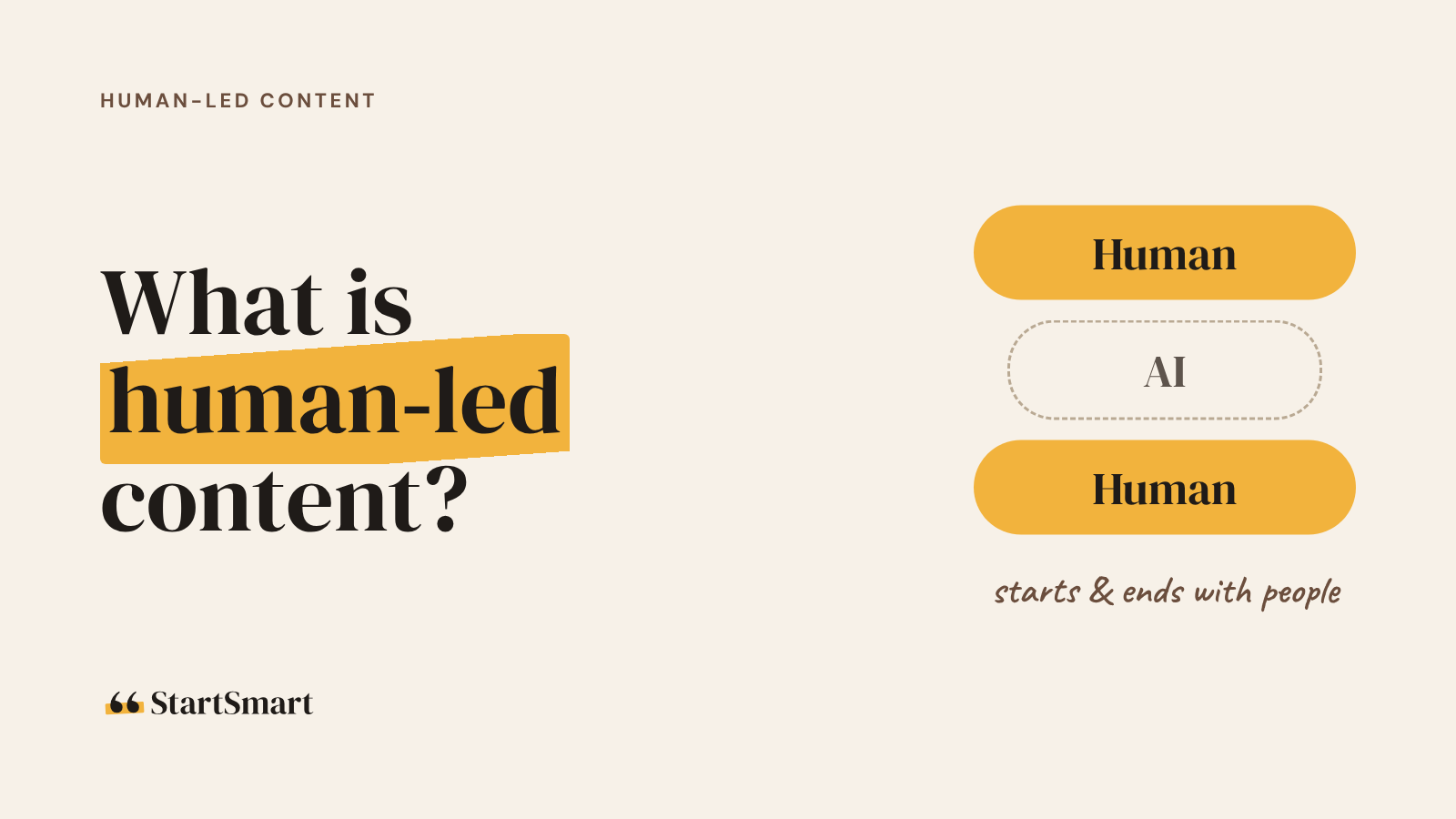
Human » AI » Human
I think about it like a sandwich. Humans on both ends, AI in the middle.
Human first. Everything starts with a conversation. I record an interview with you in Riverside (it's actually a podcasting platform, so the audio and video are great). It's just me across the computer from you, asking questions. A lot of the time you'll say something and keep right on going, and I'll stop you: wait, wait, hold on… let's go back to that. Can you tell me more? That's usually where the good stuff is. You're so close to your work that you can't hear what's unique about it anymore. Listening for it is my job.
AI in the middle. Once we have the recording and the transcript, AI is genuinely useful. It helps me organize hours of conversation, spot themes and patterns, and work faster on structure and first drafts.
Human last. Then it comes back to people. Does this sound like you? Would you actually say this? Is the story right? Nothing goes out until a human has made it true and made it theirs.
It starts and ends with humans. Always.
It's not just people who want this. Search does too.
Readers aren't the only ones paying attention. Search engines are looking for the same thing.
Google's search quality guidelines describe something called E-E-A-T: experience, expertise, authoritativeness and trustworthiness. In plain English, they're looking for content that comes from someone who has actually done the thing, knows what they're talking about and can be trusted. Not overly generic content that anyone out there could create.
And here's the part that surprises a lot of the people I work with:
"These search engines are not saying don't use AI. They're just saying that it has to be uniquely you."
That's exactly what human-led content gives you. When I interview an expert, I ask about real clients, real challenges and real results. Tell me about a time that happened. What did you do? What would you tell someone in that spot right now? The content that comes out of that conversation could only have come from that person. That's what readers trust, and it's what search is trying to reward.
What it looks like in real life
One good conversation goes a long way.
From a single recorded interview, we can rewrite your LinkedIn profile, plan months of posts, pull short video clips, draft newsletter issues and shape your website messaging. Because it all comes from your own words, it all sounds like you.
It works for teams, too. I work with a leadership development firm where the people really are the business. Their COO, director of client services, data scientist, director of coaching and founder each have their own lane of expertise, and each one shows up in their own way. So far this year, their COO's posts have earned more than seven times the impressions of the company page, from a much smaller following. Together, they reach far more people than the company page ever could on its own. And honestly? We're having so much fun building it.
How to start
You don't need a fancy setup to try this, whether you're building a business of your own or you're one of the experts inside one.
Think of a question a client asked you this week. Open your phone's voice recorder and answer it out loud, the way you would if they were sitting across from you. Don't script it. Then listen back and pull out the one line that made you think yeah, that's true.
That line is your next post.
It won't be perfect, and it doesn't need to be. People are actually very forgiving right now. If you stumble over your words or you're not a natural writer, that's okay. They aren't looking for polished. They want to know how you think and what it would be like to work with you.
You bring the expertise. I'll bring the questions.
Frequently asked questions
What is human-led content?
Human-led content is built from a real person's expertise, stories and opinions. AI can help organize and draft, but the ideas come from the person, and nothing goes out until they've reviewed it and made it their own. It starts and ends with a human.
Is it okay to use AI to write LinkedIn posts?
Yes, as a helper. AI is great for organizing notes, spotting themes and drafting structure. The ideas, stories and final judgment should come from you. When AI leads, posts start to sound like everyone else's.
How is human-led content different from AI-generated content?
AI-generated content starts with a prompt, so anyone could have produced it. Human-led content starts with your own experience: real clients, real problems, real opinions. That's what makes it specific, believable and hard to copy.
Does human-led content help with SEO?
It lines up with what Google says it looks for. Google's quality guidelines emphasize experience, expertise, authoritativeness and trustworthiness (E-E-A-T). Content drawn from first-hand experience is a natural fit for those signals.
Does human-led content work for B2B teams, or just solo experts?
Both. For a team, each expert gets their own lane of expertise and shows up as themselves, all rolling up to one brand. That kind of expert visibility usually reaches far more people than a company page can on its own.
Building something of your own? Start with the free Human-Led Content Guide or book a fit call. One of the experts on a B2B team? See how I help teams become known for what they know.