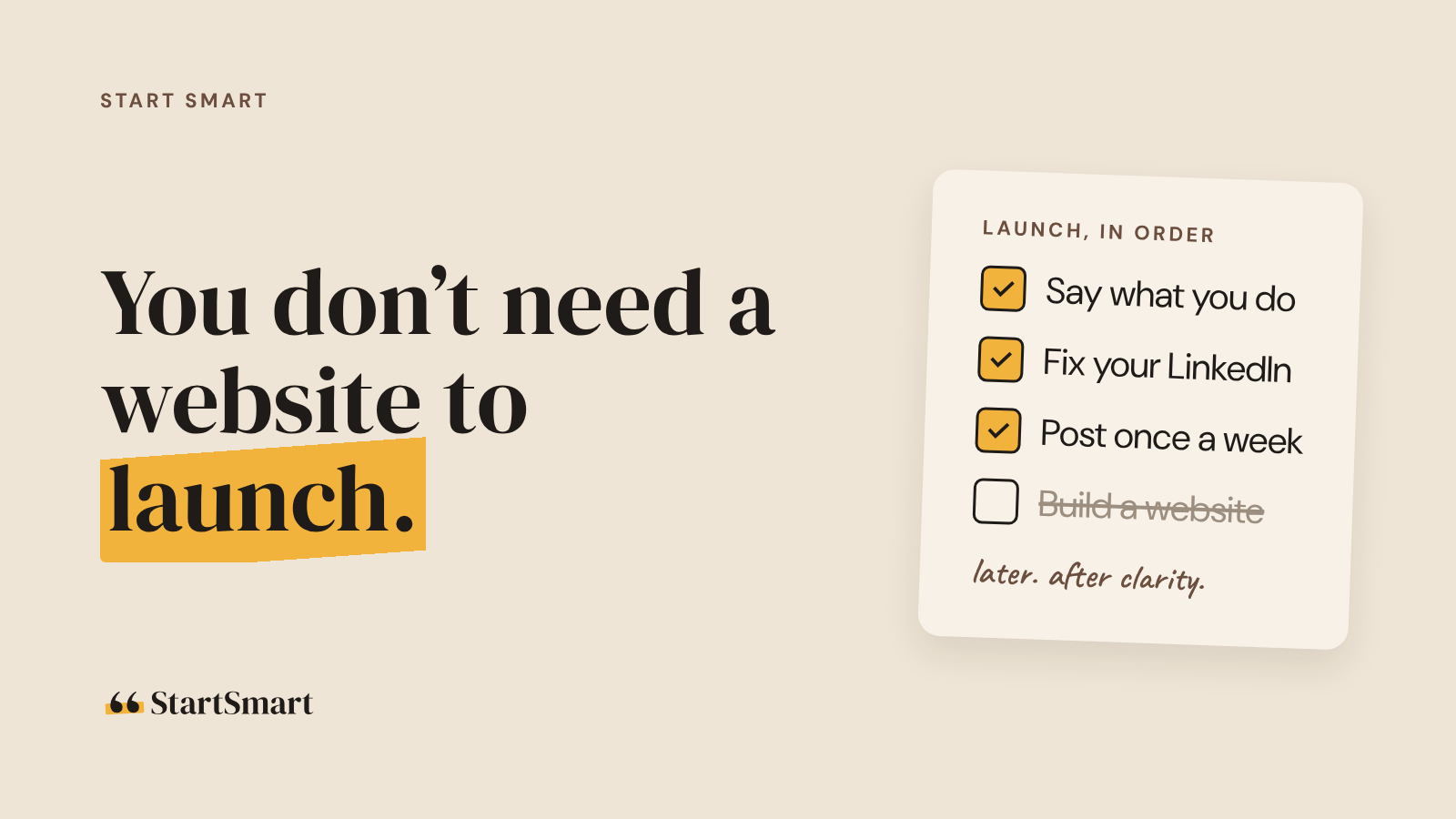
TL;DR: You don't need a website, logo or business cards to launch. You need a clear way to say what you do and a place where the right people are already paying attention… and for most B2B consultants and experts, that's LinkedIn. Build the website after you've found the words that land.
When you decide to launch something of your own, the to-do list shows up fast.
A website. A logo. Business cards. A sales deck. Maybe a brand photo shoot. If you're a high achiever (and if you're launching a business, you probably are), you want every bit of it to be absolutely perfect and professional and polished before anyone sees anything.
I get it. I really do. But this is where so many launches stall. Months go by building the stuff around the business, and the business itself never really gets out into the world.
So let me say it plainly: you don't need a website to launch your business. Not on day one.
"That's enough."
I was on a call recently with a friend who's building a consultancy of her own. She'd spent the whole weekend trying to answer every big foundational question about her business, and she came to our call feeling more unclear than when she started.
So I told her, lovingly, what I could see from the outside. She'd already made the big decision about who she wants to work with and what she provides. She had a good client who might be coming back. She had a promising sales conversation going. She had a webinar on the calendar.
"Deciding in itself can be enough without making sure that your website is updated and your LinkedIn is updated and you have all the perfect sales materials."
What she had was enough to move forward. The perfect foundation could wait.
I share that because I see it ALL the time, especially with smart, capable people. We think the foundation has to be finished before we're allowed to start. Most of the time, it's the other way around.
What you actually need first
You need two things.
A clear way to say what you do. The simple version, without the technical deep dive or the list of every service. Who you help, what you help them with and why you're the person to do it. One that makes sense to someone who isn't in your industry.
A place where the right people are already paying attention. For most consultants and experts in B2B work, that place already exists. You probably have an account there right now.
And if the marketing side of this feels intimidating, here's what I want you to know. It's actually way easier than you think it is. It's just not an expertise you have in your head. That's okay! That's what people like me are for.
LinkedIn is your first storefront
A lot of people think about LinkedIn and get this little weird feeling… ugh. They think of it as a job board, or a place to network with people they already know. You update it when you need a new job, then set it and forget it for the next few years.
But what I really wish people understood is that LinkedIn can be a living, breathing place where your expertise is consistently visible. And if you're launching a B2B business, it's a gift. It's a huge pool of professionals who are there for work, expecting to see exactly the kind of content you'd share.
A few things make it especially friendly for new businesses:
- It moves slower than other platforms. You don't have to post every day, and you definitely don't have to post several times a day.
- People are forgiving. With so much polished, AI-generated content out there, people want to see real humans. If you stumble over your words or you're not a natural writer, that's okay.
- Your clients want to know how you think. They're looking for stories about how you work and what it would be like to work with you, not a perfectly crafted product ad.
"Is it scary to put yourself out on LinkedIn? Absolutely. But it's also just this great small step and gateway to launching your business."
Three steps to launch on LinkedIn
1. Turn your profile into your storefront. Your profile is the easiest thing to fix and the first thing people check. Some people don't know how to update a website, and that can feel like a big task. Your LinkedIn profile? You can fix it this afternoon. Rewrite your headline and About section so they reflect the business you're building. You're not just an employee of someone else's company anymore. You're a person with expertise.
2. Flex your posting muscle. Start with one simple text post a week for four weeks. No graphics, no video, no strategy deck. Just get comfortable sharing in public. It gets easier every single time, I promise.
3. Tell real stories. Share a question a client asked you. A problem you solved. Something you believe about your industry that other people get wrong. Stories show your expertise better than any list of credentials ever could.
Then pay attention. People will start reaching out and asking what you do. That's when the ball really starts rolling.
So when do you need a website?
Eventually, yes. A website gives you a home base you own, a place to send people and a way to build your own email list.
But it works best after you've gotten clear on your message. When you've spent a few months talking about your work out loud, you know which words land, which stories people respond to and what people keep asking you about. Then the website practically writes itself.
I'm living this right now, actually. I just rebuilt my own website, and the copy came straight from things I've been saying on calls and on LinkedIn for months. I even recorded myself being interviewed about my own business… the same way I interview my clients… and pulled the words from that.
Website after clarity. Start first.
Start smart
That's really where my business name comes from. If you're launching something, you don't need to have everything in place. You just need to do the right things first.
For most experts, the right first thing is simple: get clear on what you want to be known for, then start talking about it where your people already are.
Frequently asked questions
Do I need a website to start a consulting business?
Not on day one. To get started, you need a clear way to explain what you do and a place where your potential clients already spend time. For most B2B consultants, that's LinkedIn. A website can come once your message is clear.
Can I use LinkedIn instead of a website?
In the beginning, yes. A strong LinkedIn profile works as your first storefront: it shows who you help, what you do and how you think. Over time, you'll want a website and an email list you own, too.
When should I build a website for my business?
After you've spent a few months talking about your work in public. By then you know which words land, which stories people respond to and what people keep asking, so the website copy is much easier to write.
How do I set up my LinkedIn profile for a new business?
Rewrite your headline and About section around the business you're building: who you help, what you help them with and why you're the right person. Lead with your expertise, not your last job title.
Want a hand with the first steps? My free Out Loud challenge walks you through your LinkedIn storefront and your first post in five days. Or, if you'd rather have someone do it with you, the Starter Kit gets you a messaging platform, a rewritten LinkedIn profile and three months of posts in your voice.